Showing posts with label 1930s. Show all posts

Friendly Acres Airport

It was 1926 and both Daniel Stafford and the Redwood Committee had lost the bid to establish the San Francisco airport on Sweeny Ranch lands (read more in the post on Sweeny Ranch Airport) - lands that adjoined the Redwood City airport.  That loss lead to the creation of the neighborhood we know as Friendly Acres.

However the Second World War only served to resurrect those commercial airport aspirations. And at the end of the war, in the late summer and fall of 1945, David Dewey Bohannon proposed the idea of building an airport at the end of Marsh Road.

Bohannon, like Daniel Stafford before him, was a real estate developer who had purchased the Belle Haven Tract from Harry Friend who, in turn, had originally purchased Belle Haven in 1935 during the depression.  Belle Haven represented the most easterly parcels of land of the old Sweeny Ranch (ranch lands carved out of the original Pulgas Rancho).

Despite the high and rapid turnover of owners, Redwood City airport, between Chestnut and Woodside road, had continued to operate during the 30s and 40s and the airfield was commonly referred to during the 2nd World War as Sanders' field.

No doubt influenced by the war time aviation activity, and the superb geographic conditions which the Navy had written about in 1916, coupled with Redwood City's 1925 slogan of "Climate Best by Government Test", Bohannon had pitched the idea of rezoning 72 acres of land north and east of Marsh Rd on the northern side of Bayshore Highway to create an airfield by the bay. 

At 72 acres, the proposed extent of land for the Friendly Acres airport (what we know today as the Industrial Park area) would have been a little under four times the size of today's Bayfront Park, at the end of Marsh Road, which is about 22 acres.
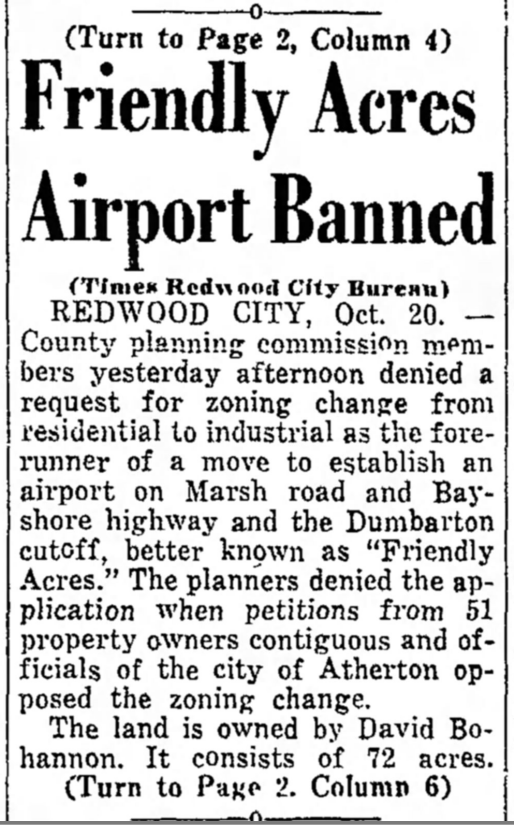
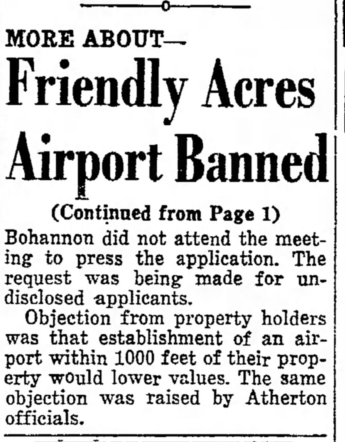
The Times, San Mateo, CA, Oct 20 1945

But Sander's Field, and the war in general, had given the residents of Friendly Acres its share of aviation mishaps:  noise from low flying aircraft, plane crashes by flying aces (read about the crash landing here), and bombs being dropped on the neighborhood, (more about the warhead incident here) were just a few of the trials that befell local residents.
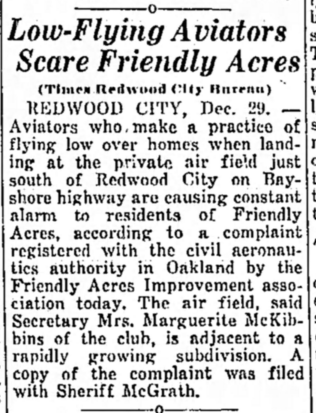
The Times, San Mateo, CA, Dec 29 1939


Inevitably, the combined communities of Friendly Acres and Atherton saw fit to deny Bohannon's application for an airfield citing noise and land value depreciation as objectionable.

Unable to develop the airport, Bohannon went on to build 1305 homes in the Belle Haven Tract, (today, in East Palo Alto and East Menlo Park), which they envisioned as "a home builder's paradise where wildflowers bloom year 'round..."  


Sources:

  • San Mateo County Genealogy, SF Place Names, Belle Haven: http://www.sfgenealogy.com/sanmateo/smplaces.htm
  • Friendly Acres Airport Banned - San Mateo Times, Oct 20 1945
  • Low Flying Aviator Scare Friendly Acres - San Mateo Times, Dec 29 1939


Sweeny Ranch Airport

The residential development of Friendly Acres in the early 1930s carved up the last of the ranches in the southeastern end of San Mateo County - the notable Sweeny Ranch.  This was in fact the last of the Arguello marsh lands from the old Pulgas rancho.

From about the 1880s the lands just south of Redwood and east of Menlo Park were known as Sweeny Ranch lands, after Myles D. Sweeny who bought the property from the Arguello estate when the Pulgas Rancho went up for sale and was subdivided.  Today, the Sweeny name survives - but just barely. 

You can find it in the land titles of the unincorporated properties in the Sweeny Ranch subdivision in Menlo Park, south of Marsh Road and east of Bay St.  Only about a dozen houses remain today that can still lay claim to being on the historic Sweeney Ranch and they're in unincorporated Redwood City and Menlo Park.

And it continues on in the name of the train stop at Marsh Manor, which still exists today, as a flag stop station - listed in the Southern Pacific railroad schedules, as Sweeny Ranch station.  Yes, that train barrier across Marsh Road is in fact a flag stop station.  But more on that in another post.

And the name continues to exist in the name of Sweeney Ave,  a road just off of Bay Road, opposite the Ampex campus, named after Miles D. Sweeney.  [Editor's note: the variation on the spelling of Myles Sweeny's name in the historical records is common.  The given spelling, based on the 19th Century census records, is without an "e" before the "y".

Today's post, however, is not about the landowners of the rancho lands that Friendly Acres grew out of, but of the airport that we once almost became. 

At the turn of the 20th century, aviation and cars were the huge technological advances which revolutionized transportation and catapulted the world into the modern era.  And from 1911 thru the decade of the roaring 20's, Redwood City was THE place to be on the San Francisco Peninsula if you wanted to watch an airshow or learn to be an aviator.

In the winter of 1926 the San Francisco Airport committee had a shortlist of eight sites to visit - on both sides of the bay, with three of them being in San Mateo County: Coyote Point, Brewer's Island and Sweeny Ranch.

Mr. E. W. Holt, spokesman for the Redwood City Chamber of Commerce encouraged the San Francisco Supervisors to inspect the Sweeny Ranch site describing it as follows:  "The climatic conditions are perfect, insuring perfect flying weather at all times."

Doesn't that sound familiar?  It should.  He was paraphrasing the "Climate Best by government Test" slogan that the City had only recently adopted in the previous year, in 1925, and had placed over their gateway arches into town.

The strategic importance of "climate" as a resource was a big deal to the Peninsula Cities who were interested in attracting San Francisco workers and residents to its green commuter belt and weekend suburban country homes.  Redwood City already had the Redwoods as a business and marketing commodity in its name.  Not being plagued by fog, all it needed was a branding slogan for its perfect weather.  And it intended to capitalize on its micro climate as a strategic resource.

The so-called government test of 1912 was conducted in tandem with the German government, and its likely that the chamber of commerce rallied to have Redwood City submitted as a test site.  And its highly conceivable that Daniel Stafford, one of the city's most influential merchants and business men, was a strong advocate for having the city used as a test site at that time.  The push to market the weather with empirical findings was something that smelled of Daniel Stafford - as the city's largest merchant and a significant real estate and insurance investor he was also one of its biggest promoters.  The climate slogan wasn't just about immortalizing a government report, it was about bringing in big business, big money and big residents.

The Sweeny Ranch site was a late entry to the airport selection game and consisted of 487 acres of marsh land (7000 feet long and 3000 feet wide), which Stafford had recently purchased, located along the Dumbarton cutoff of the Southern Pacific railroad.  (This was the area later to be known as Friendly Acres.)

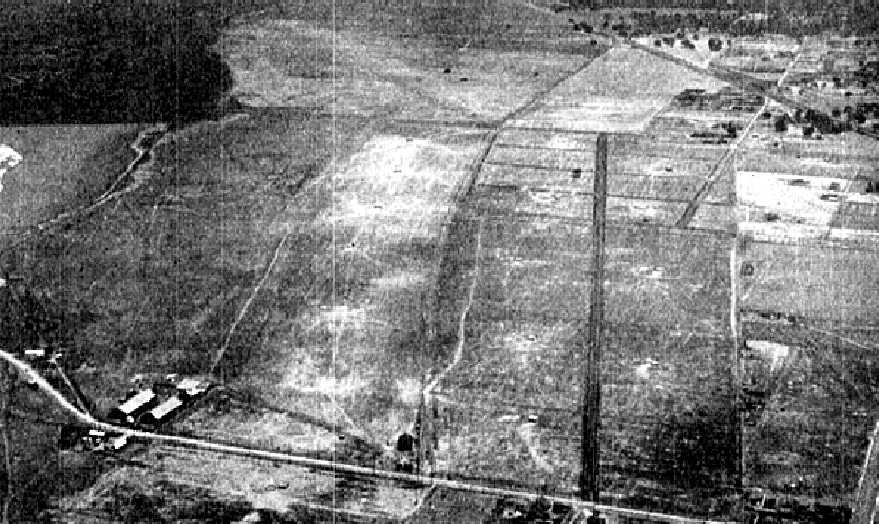
Image showing Redwood City Airport / Sanders field and Sweeny Ranch lands / Friendly Acres still intact.  An undated aerial view looking east from The Airport Directory Company's 1938 Airport Directory (courtesy of Jonathan Westerling).  The Dumbarton rail line crosses diagonally at the top right of the photo.  Image source from a fantastic site at: Abandoned and Little known Airfields: CA-San Jose area curated by Paul Freeman.
 
Stafford's Sweeny Ranch airport would include the eastern end of Lynch Field, (today the Ampex lands) extending the Sanders Field air strip, which was the existing Redwood City Airport that stretched from Chestnut to Woodside Road.  That eastern end went from Woodside Road to 2nd Avenue, making use of grassland that was being used for grazing cows.

Lynch field was named after Michael Lynch who had purchased a subdivision of the Sweeny Ranch from Regina Pescia (nee Regina Anastasia Sweeny, daughter of Myles D. Sweeny)  in 1898, and used it as a secondary nursery location to grow flowers and cultivate seedlings for the flower trade.

Michael Lynch died in 1905, and his family sold it in June of 1916 to Silas Christofferson, the famous aviator and plane engineer who, aided and abetted by the Redwood City Chamber of Commerce, established his flying school in 1916.

Christofferson had planned to expand and develop the Redwood City airport to the southern end of Lynch field (where Broadway today continues from Woodside Rd to 5th Ave), with a view to manufacturing military airplanes. (In Europe, WWI was at its peak - and Christofferson had ideas for specialized engines and aircraft based on his experience flying for Pancho Villa's army in 1915 during the Mexican Revolution).  But on Halloween of 1916, while test flying a new military plane which he had designed, over the Bay around Redwood City,  the plane's engine died.  Unable to coast it, the plane nose dived and he dropped 100 feet down on to Lynch field, crashing to his death just 4 months after purchasing the fields and airstrip. The young daredevil and brilliant aeronautical mechanic, was only 26.  The airfield was subsequently referred to as "Christofferson field".

Following the tragedy which made international headlines, Frank Bryant who had worked for Christofferson as chief trainer of the flying school, bought out the airport property, and renamed it the Redwood City School of Aviation.

But only three years, later, in 1919, Bryant sold out to the ambitious Walter Varney who had other fields in San Mateo and had ambitions to run a postal air distribution service from San Mateo, as well as aerial taxi services.

Varney also shipped flowers by air from the greenhouses of Redwood City and was subsequently to become  the founder of United Airlines and co-founder of Continental.  During Varney's time until the early 30s when the land was again sold off, the air fields were also referred to as Varney's field

San Mateo Times, November 13 1926
The Redwood City Chamber of Commerce, together with Stafford who had become a Member of the Redwood City Board of Trustees only 3 months previously, offered up the land at $1,000 an acre and promised that it could be made fit for flying conditions in a short space of time - and that the only impediment, they could find was a telephone pole line that crossed the ranch, which could be moved quite easily.

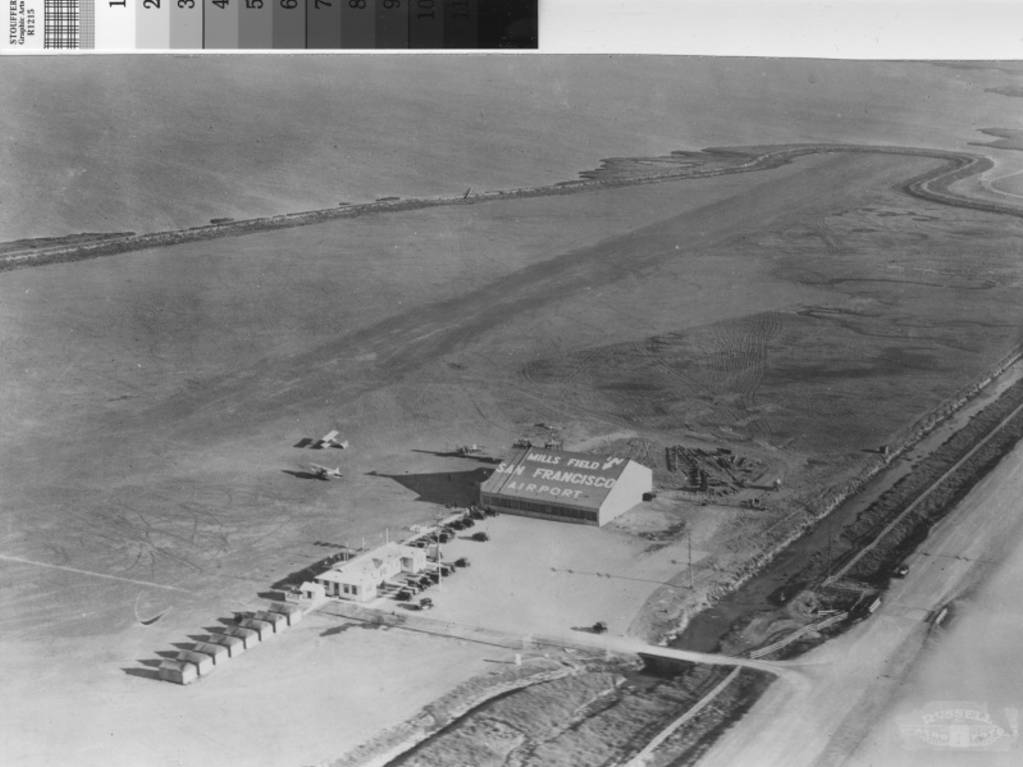
Despite the weather, it all came down to location, location, location.  Aviators of the time seemed to favor a San Francisco-Oakland airfield.   And the distance from San Francisco, regardless of the fog, was the primary reason why Mills Field in San Bruno ultimately won out.  Today, with the delays in takeoff due to the fog, some may question the wisdom of that decision.

Aerial view of Mills Field Municipal Airport, ca. 1927, Creator: Russell Aero Foto (Firm) |
Online Archive of California (OAC) - Contributing Institution: San Bruno Public Library

Well, we all know that ultimately the San Francisco Airport Committee chose to go north in their location decision.  Daniel Stafford and the City commissioners must have been presumably disappointed.

[But what a good thing that was for all us who live in the neighborhood today.]

Despondent with losing the airport bid, Stafford sold out to outside developers who purchased the adjoining eastern side of Lynch field and adjoining lands to Marsh Road, intending to build a project which they called the" Sweeny Ranch subdivision" which would include Friendly Acres, Belle Haven and Dumbarton Acres.

Retired cattleman turned capitalist and real estate developer Abraham G. Frank who had fled his native Holland just before the Nazi invasion, settling in San Francisco, had bought the Redwood City airport from the Michael O'Dea estate in 1941.

Frank signed over a 10-year lease of the 109-acre airport site with an option to buy, to Lee Cox of the Stinson Flying Corporation, in October of the same year.  Cox intended to turn it into a Training School for Pilot Instructors for army air corps cadet training centers.  The site would also include an aircraft mechanics school for those seeking accreditation, as well as training facilities for private pilots on Aeronca craft and  Stinson planes manufactured by Vultee.  Redwood City was to become the pacific coast headquarters for the Stinson Flying Corp.

Notes:
  1. Probably the best description we have for the Sweeny Ranch or Sanders Field airport, in terms of its size and location from Redwood City's business center, is in the Airway Bulletin of 1934.  Sanders Field is described as:  "Sanders Fieldcommercialrating auxiliary airportSix city blocks E. of business centerAltitude10 feetRectangular5,200 feet by 1,200 feetsodlevelnatural drainageone runway4,700 by 350 feetentire field also available."
    Airport Advertisement in the San Mateo Times, Dec 13 1930

  2. Even the U.S. Marine Corps back in 1916 in their survey scouting for possible naval aviation fields around the Peninsula had determined that there were really only 2 suitable locations in the Bay area for flying fields:  Mare Island which the navy already owned, and the location today known as Seaport Boulevard in Redwood City.  Mare Island was preferred as it was already owned by the Navy.  But Redwood City's Seaport area was considered to be far superior than even any other possible site further south in the State that the navy might be interested in and could be used as a naval aviation training base.   First Lieutenant Alfred A. Cunningham who scouted the Peninsula in 1916 for possible naval aviation base locations, concluded in his report however that the marshlands around Redwood City were cut up entirely by sloughs and did not possess enough advantages for aviation purposes unless they were filled in.  He had scoped out 3 sites in Redwood City - the Seaport Blvd marsh land, the Salt Beds south of Seaport (the area today owed by Cargill) and the adjoining Marshes and marsh lands south of there.  The Sweeny Ranch lands were likely included in the marshlands assessment.
  3. At the close of war in 1945, David Bohannon attempted to resurrect the idea of an airport at Friendly Acres but the idea was firmly shut down by residents both from Friendly Acres and Atherton.  (Read more here on Bohannon's Friendly Acres airport.) 
  4. While Redwood City Airport no longer exists, there is one building that still remains from those early halcyon days, originally known as the Aviation Cafe, today the Apatzingan restaurant. (Read more here on Vestiges of Redwood City Airport.)  
Sources and References:


Raising Backyard Chickens

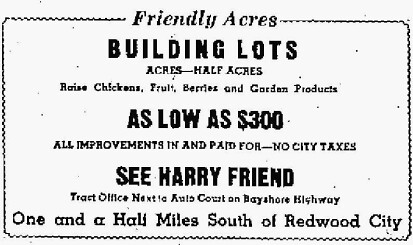
While real estate advertising for Friendly Acres of the 1930s and 40s pitched the opportunity of raising chickens in your new plot of land - chook farming seems to have been something that has ebbed in and out of fashion - but nonetheless continued to appeal to successive generations.

I didn't realize how much of a marketing factor raising chickens was to the purchase of buying a home in Friendly Acres back in the day, until I came across some old real estate ads for the district.  It really was part of the sales pitch for the middle to working classes.  The depression of the 30s had made self-sufficiency a buzz word.  And in the 40s it was very much part of the War Dept.'s  homefront strategy of thriftiness tied in with the Victory Gardens program.
March 28, 1938.  Burlingame Times and Daily News.


The Peninsula's Fastest growing district

By June 1936, Harry Friend who was 46 by now, was already an established realtor up and down the Peninsula and living in Friendly Acres, with 6 homes already built in the district and ten more under way.

Having purchased several hundred acres of the Sweeny Ranch, south of Redwood City and on the eastern bayside of Fair Oaks, he was continuing a tradition of development and home building that had started before him with the creation of the Fair Oaks subdivision after the 1906 earthquake, which lured San Franciscans to the seemingly safer and more bucolic southern end of San Mateo County. 

One of the earliest advertisements for Friendly Acres is from 1936 showing him headquartered out of San Francisco and operating a local tract office.

The Friendly Castle

While visiting the San Mateo County Archives one weekend, I found a newspaper article on Friendly Acres.  It appeared to be the only newspaper article that they had on file (at that time) for the neighborhood, or with any mention of Harry Friend.

The clipping, entitled "A Backward Look: Restoration at 'Friendly Castle'" - Archive Reference # 75-604.1 RC, is undated but it does include the name of the author, a Marian Goodman, who had been a Staff writer with the Redwood City Tribune.
The big white Spanish-type "Friendly Castle" was built by Harry Friend, who subdivided and developed Friendly Acres in February 1934, selling lots for $20 down.

The article introduces us to Ray and Pat Dufour, the then new owners of the "Friendly Castle" who had just moved in, (this is around 1966), and were redecorating the interior, and provides a retrospective of the previous owners and the significance of the house to the neighborhood.
"... This interesting house was built in 1934 by Harry Friend, who once owned all of Friendly Acres, as well as the Industrial Park area which he sold to David Bohannon.  He also donated two acres of land for Taft school.  
One neighbor recalls being offered $400 for the whole acreage, then a salt swamp.  "Are you kidding?" she said, "I wouldn't have it for anything!"
For some time the Friendly Castle was the only house in the area, and it was outstanding because of its size, prominence, and unusual design.  Friend knew just how he wanted it, and how he got it is quite a story.
In Russia, the last of the czars, Nicholas II, had a personal architect, a Russian Pole, named Kapliroff, who designed buildings for the emperor.
During the Russian revolution when the Czar and his family were murdered by the Bolsheviks, Kapliroff escaped, and was smuggled out of the country in a barrel.
He made his way to America, crossed the country, and happened to stop in Redwood City.  He knew no English, but he met Harry Friend, who could speak Russian because he was born in Poland of Russian descent.
The two got along well, and when Kapliroff found that Friend wanted an architect to help with his new house, he was glad to oblige.
Otherwise, because of Kapliroff's language difficulty he didn't do well here.  But someone suggested he go to Hollywood where they could use his type of designs.  He did go to Hollywood and made a fortune before he died. 
The Friends entertained a great deal in their showplace, and people came from all over Northern California to see it.  Students came from Stanford to make sketches, and demands for the plans resulted in a few similar houses being built in Palo Alto. 
But the Friends lived in the house only five years."
Goodman provides further descriptions of the interior of the house and renovations underway and ends the article by letting readers know Mrs Friend's current address.  Already a widow by 1966, when this interview was given, Mrs. Friend was no longer living in Friendly Acres.  The Friends had left the neighborhood in 1939 to settle in San Carlos, where Mr. Friend had a "smaller and less elaborate" house built for her, modeled on the larger one in Friendly Acres.

Apparently the reason for the move was that the house became too much for Mrs Friend to care for and she became ill.  Its interesting to note that Irene Winnick's oral history essay also indicates that Mrs Friend was ill but the reason they chose San Carlos was because it was "higher and drier" than "the salt swamp" and that they first moved to San Francisco for a while before settling down in San Carlos.  (I presume they stayed in San Francisco either for medical care, or while they waited for their house in San Carlos to be built.) 

The article provides other descriptions of the interior of the Friendly Castle and talks about subsequent owners who went on to occupy the place, including a Mr. Preston, a Gillette representative, and a Milton Engel - a chemist.  (Editor's Note: Watch this space for an upcoming post on Milton's story which is decidedly colorful).

Special Note - Ms. Goodman, who wrote the article for the Redwood City Tribune, also wrote pieces on San Mateo history and, notably, would accompany her submissions with hand illustrations of the topic she was writing about.  I came across 2 publications where she's also cited as the illustrator - and clearly an accomplished one.
  • Missions of California; Marian Goodman, Redwood City Tribune, 1962
  • San Mateo County: Its Story; Marian Goodman, Goodman Publishing Co., 1967
 
Judging by the covers of these 2 books I suspect that the illustration of the Friendly Castle which was in the Friendly Acres article (see below) was most likely also done by Goodman.


National Motor Bearing

It seems that if you lived on the Peninsula between 1935 and 1970 there was a high probability you or someone in your immediate sphere of acquaintance, worked at the "National Motor Bearing Co." (NMB), in Redwood City. 

Originally founded in 1920 in San Francisco, by Lloyd A. Johnson, NMB initially established a plant in Oakland, which was then moved to Redwood City in 1942.  Johnson, a man who had built his company from scratch,  went on to invent and patent in 1936 the process of making laminated shims. 

This was a big deal.  Shims are thin pieces of metal or composite used to fill in space between components for adjustment of fit in mechanical assembly.  It is a valuable design and assembly tool that replaces machining and grinding of component parts to achieve the required accuracy.  During WWII - this was an advantage as it reduced the assembly time of machined components, by eliminating the need to regrind or repair inaccuracies in machining.

Shims are usually applied to rotating shafts and sliding surfaces where wear or crushed forces affect a component part.  They have many applications in different fields:  Pumps & motors, motor support struts, thrust reversers, fuselage, landing gears, gas turbines, Hydraulic controls, refrigeration, and industrial ventilation machines, injection  molding,  extrusion,  printing,  paper machinery, Machine tools, Automotive, Aircraft, Aerospace market; Agriculture and civil engineering equipment.

All along the top of the exterior walls of the Redwood City factory plant building, its branding shouted out exactly what it did: NMB produced "shims and oil seals",  for transportation - trains, planes, automobiles, ships, subs - you name it.  It was a key defense industry during WWII and one of, if not, the major employer of the city at that time.  It also had 2 subsidiaries: the Arrowhead Rubber Co., and National Seal Co.

In 1956, the company merged with Federal-Mogul Bower of Detroit which propelled NMB as one of the top 300 companies of the country. 

But prior to being bought out by Federal-Mogul, NMB was one of the most modern high tech places to work at - and all this courtesy not just of its products and workforce - but because of the amazing Advertisements, dreamed up by Arthur Radebaugh in the Marketing & Advertizing Dept.  Radebaugh worked for NMB between 1951 and 1955, when it was at its all time brand peak - immediately before it was bought out by Federal Mogul. (Click here to view some of NMBs amazing futuristic advertizing and read more on the story of Arthur Radebaugh.)     

The plant occupied the site on Broadway, between Chestnut Street and Woodside Road - which today is the Broadway shopping center site - where the Denny's, CVS (Longs) pharmacy and Big Lots are. 
National Motor Bearing Co of Redwood City, in 1948, to the left of the image - with Friendly Acres right of the red border.   
In looking at an aerial map of Friendly Acres from 1948, NMB is almost the first Redwood City site you would have encountered as you walked or drove into town from the neighborhood, with 2 rail spurs coming off Chestnut for loading bays on two sides of the building.  Woodside Rd with its clover leaves to Bayshore Hwy, as we know it today, still hadn't been built.  Neither had the Broadway extension down to Friendly Acres.  Broadway looks like a road that ended just beyond NMB on the other side of Woodside and then became a a trail through open fields down to Friendly Acres. 

Friendly Acres was surrounded by open pastureland to the north, east and west.  Marsh Manor shopping center was still a field.  And orchards seemed to fill the empty lots behind many gardens in the Friendly lots. 

The National Motor Bearing plant in Redwood City eventually closed in 1971, however Federal Mogul continues to operate today.

References & Other External Links
Over at Bits of History, curated by the Redwood City Public Library and San Mateo County Historical Association, they have an interesting digital collection of local historical photos for public viewing.  Three interesting photos on National Motor Bearing can be viewed here:  
  1. Exterior of the Building - circa 1950
  2. Interior of the Building - c. 1950
  3. Great aerial view of South side of Redwood City, 1947, with NMB in foreground and Friendly Acres at the top of the image.
Historic Aerials by Netr Online, is a wonderful site where you can view other aerial maps from previous decades.  Looks like 1948 is the earliest historic aerial they have.  You can purchase the maps online, (which also make for great present ideas).