Showing posts with label 1940s. Show all posts

Friendly Acres Airport

It was 1926 and both Daniel Stafford and the Redwood Committee had lost the bid to establish the San Francisco airport on Sweeny Ranch lands (read more in the post on Sweeny Ranch Airport) - lands that adjoined the Redwood City airport.  That loss lead to the creation of the neighborhood we know as Friendly Acres.

However the Second World War only served to resurrect those commercial airport aspirations. And at the end of the war, in the late summer and fall of 1945, David Dewey Bohannon proposed the idea of building an airport at the end of Marsh Road.

Bohannon, like Daniel Stafford before him, was a real estate developer who had purchased the Belle Haven Tract from Harry Friend who, in turn, had originally purchased Belle Haven in 1935 during the depression.  Belle Haven represented the most easterly parcels of land of the old Sweeny Ranch (ranch lands carved out of the original Pulgas Rancho).

Despite the high and rapid turnover of owners, Redwood City airport, between Chestnut and Woodside road, had continued to operate during the 30s and 40s and the airfield was commonly referred to during the 2nd World War as Sanders' field.

No doubt influenced by the war time aviation activity, and the superb geographic conditions which the Navy had written about in 1916, coupled with Redwood City's 1925 slogan of "Climate Best by Government Test", Bohannon had pitched the idea of rezoning 72 acres of land north and east of Marsh Rd on the northern side of Bayshore Highway to create an airfield by the bay. 

At 72 acres, the proposed extent of land for the Friendly Acres airport (what we know today as the Industrial Park area) would have been a little under four times the size of today's Bayfront Park, at the end of Marsh Road, which is about 22 acres.
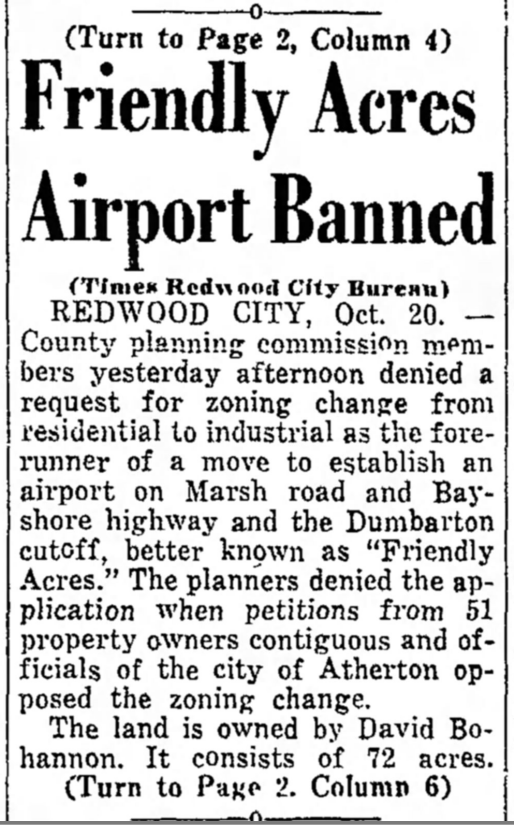
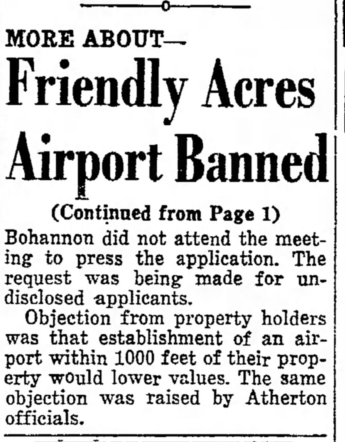
The Times, San Mateo, CA, Oct 20 1945

But Sander's Field, and the war in general, had given the residents of Friendly Acres its share of aviation mishaps:  noise from low flying aircraft, plane crashes by flying aces (read about the crash landing here), and bombs being dropped on the neighborhood, (more about the warhead incident here) were just a few of the trials that befell local residents.
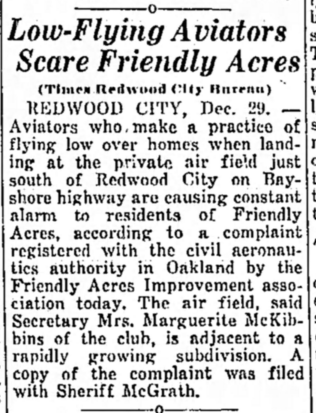
The Times, San Mateo, CA, Dec 29 1939


Inevitably, the combined communities of Friendly Acres and Atherton saw fit to deny Bohannon's application for an airfield citing noise and land value depreciation as objectionable.

Unable to develop the airport, Bohannon went on to build 1305 homes in the Belle Haven Tract, (today, in East Palo Alto and East Menlo Park), which they envisioned as "a home builder's paradise where wildflowers bloom year 'round..."  


Sources:

  • San Mateo County Genealogy, SF Place Names, Belle Haven: http://www.sfgenealogy.com/sanmateo/smplaces.htm
  • Friendly Acres Airport Banned - San Mateo Times, Oct 20 1945
  • Low Flying Aviator Scare Friendly Acres - San Mateo Times, Dec 29 1939


Flying Ace crashes in Friendly Acres

World War II came to a sudden and vivid reality for residents of Friendly Acres in Redwood City late one Monday afternoon in 1943 when a fighter plane made a spectacular crash landing into the neighborhood.

It was April 12th and a young 25 year old army flier from Callendar, Iowa, 2nd Lt. Lowell K. Brueland, had been on a practice flight on a single-seat fighter plane over the bay. Heading west over the San Mateo Bridge from Hayward AFB, his plane suffered engine trouble and he was forced to quickly find somewhere where he could make an emergency landing.  Running out of possibilities he stayed close to the shoreline of the bay aiming for some sort of belly landing, and managed to get himself to Sanders' field (aka Sweeny Ranch airport) just south of Redwood City, which had in earlier days been a private airport.  (Today the Ampex land just north of 2nd Ave. and south of Chestnut in Redwood City).

To his credit, the pilot maneuvered the plane with such skill that no damage was made to any house or car although he skimmed them by inches.  Not only did Brueland survive to tell the tale, but he we went on to become one of  WWII's Flying Aces and the legendary Pioneer Mustang flyer of "Grim Reaper" fame.

The Chicken Warhead Incident

And continuing on the chicken theme from previous posts.... you'll agree that the odds of a bomb dropping on American soil during World War II in someone's backyard was, well, low - right?

Granted, there were some strange things happening in 1945...but of course we're also talking about Redwood City, CA - so where else is a bomb going to drop -but on your friendly chicken coop in our own Friendly Acres neighborhood, naturally.

In a really unusual story that made the front page of the San Mateo Times, of July 17 1945, and then disappeared from the news headlines completely, (loose lips sink ships, and all that!), this is an interesting piece from the archives that definitely deserves a place in our neighborhood history.  Herewith transcribed for your delectation:

No president, no flood, no fire - "a great community"

Jeanette Giovannoni's homework assignment was the second oral interview transcript regarding Friendly Acres that I found at the Redwood City Archives.  Irene Winnick's essay/transcript was the first.  Irene's work is from April 12, 1945, the day F.D.R. died -  but Jeanette's essay is undated.  When I initially saw them I presumed they were written in the same year, for the same class, but they may have conceivably been written a couple of years apart.   Both documents are wonderful artefacts and a creative way of recording and preserving local history information. 

Both girls spoke to Mr. Giovannoni to get information.  While Irene Winnick spoke to several people, Jeanette interviewed one person only: - Giovannoni.  Her excuse for not interviewing anyone else smacks of classic chauvinism, maybe that's because Giovannoni was her father? - then again, it could simply be teenage unwillingness to complete assigned homework, for whatever reason. 

For those of us in the know, Giovannoni's comment on the lack of flooding is an eyebrow raiser...  Presumably, rain and storm runoff in those days had a better chance of getting back into the bay. 


National Motor Bearing

It seems that if you lived on the Peninsula between 1935 and 1970 there was a high probability you or someone in your immediate sphere of acquaintance, worked at the "National Motor Bearing Co." (NMB), in Redwood City. 

Originally founded in 1920 in San Francisco, by Lloyd A. Johnson, NMB initially established a plant in Oakland, which was then moved to Redwood City in 1942.  Johnson, a man who had built his company from scratch,  went on to invent and patent in 1936 the process of making laminated shims. 

This was a big deal.  Shims are thin pieces of metal or composite used to fill in space between components for adjustment of fit in mechanical assembly.  It is a valuable design and assembly tool that replaces machining and grinding of component parts to achieve the required accuracy.  During WWII - this was an advantage as it reduced the assembly time of machined components, by eliminating the need to regrind or repair inaccuracies in machining.

Shims are usually applied to rotating shafts and sliding surfaces where wear or crushed forces affect a component part.  They have many applications in different fields:  Pumps & motors, motor support struts, thrust reversers, fuselage, landing gears, gas turbines, Hydraulic controls, refrigeration, and industrial ventilation machines, injection  molding,  extrusion,  printing,  paper machinery, Machine tools, Automotive, Aircraft, Aerospace market; Agriculture and civil engineering equipment.

All along the top of the exterior walls of the Redwood City factory plant building, its branding shouted out exactly what it did: NMB produced "shims and oil seals",  for transportation - trains, planes, automobiles, ships, subs - you name it.  It was a key defense industry during WWII and one of, if not, the major employer of the city at that time.  It also had 2 subsidiaries: the Arrowhead Rubber Co., and National Seal Co.

In 1956, the company merged with Federal-Mogul Bower of Detroit which propelled NMB as one of the top 300 companies of the country. 

But prior to being bought out by Federal-Mogul, NMB was one of the most modern high tech places to work at - and all this courtesy not just of its products and workforce - but because of the amazing Advertisements, dreamed up by Arthur Radebaugh in the Marketing & Advertizing Dept.  Radebaugh worked for NMB between 1951 and 1955, when it was at its all time brand peak - immediately before it was bought out by Federal Mogul. (Click here to view some of NMBs amazing futuristic advertizing and read more on the story of Arthur Radebaugh.)     

The plant occupied the site on Broadway, between Chestnut Street and Woodside Road - which today is the Broadway shopping center site - where the Denny's, CVS (Longs) pharmacy and Big Lots are. 
National Motor Bearing Co of Redwood City, in 1948, to the left of the image - with Friendly Acres right of the red border.   
In looking at an aerial map of Friendly Acres from 1948, NMB is almost the first Redwood City site you would have encountered as you walked or drove into town from the neighborhood, with 2 rail spurs coming off Chestnut for loading bays on two sides of the building.  Woodside Rd with its clover leaves to Bayshore Hwy, as we know it today, still hadn't been built.  Neither had the Broadway extension down to Friendly Acres.  Broadway looks like a road that ended just beyond NMB on the other side of Woodside and then became a a trail through open fields down to Friendly Acres. 

Friendly Acres was surrounded by open pastureland to the north, east and west.  Marsh Manor shopping center was still a field.  And orchards seemed to fill the empty lots behind many gardens in the Friendly lots. 

The National Motor Bearing plant in Redwood City eventually closed in 1971, however Federal Mogul continues to operate today.

References & Other External Links
Over at Bits of History, curated by the Redwood City Public Library and San Mateo County Historical Association, they have an interesting digital collection of local historical photos for public viewing.  Three interesting photos on National Motor Bearing can be viewed here:  
  1. Exterior of the Building - circa 1950
  2. Interior of the Building - c. 1950
  3. Great aerial view of South side of Redwood City, 1947, with NMB in foreground and Friendly Acres at the top of the image.
Historic Aerials by Netr Online, is a wonderful site where you can view other aerial maps from previous decades.  Looks like 1948 is the earliest historic aerial they have.  You can purchase the maps online, (which also make for great present ideas).

Flames of Red Feathers

In reading Irene Winnick's paper on Friendly Acres and researching some of the local businesses she mentions, I was amazed to see how many of these places had burned down - in some cases more than once.  Not because "everything is made of wood out there" as my mother keeps reminding me, but because the safety procedures and security controls which are inherent in all modern businesses were still rudimentary even in the mid 20th century.

The Red Feather factory mentioned in Irene Winnick's paper on Friendly Acres, or Red Feather Products Inc, just like Frank's Tannery were businesses located by the shoreline, or by the creeks for good reason: they used volatile chemicals and needed a water outlet, and also used water in their own production processes for rinsing and cooling.   But despite access to water, both businesses burned down.